Destruction Zone is an arcade and strategy science fiction tank war game. The camera views the robot and human controlled tanks from above, and players fire at each other, saving money with which they can shop for better weapons. The game is simple on the surface but rich in strategy.
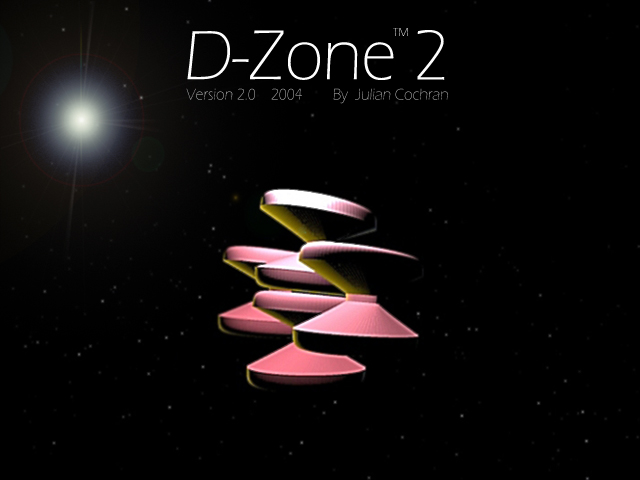
Version 1.0 was written as a PC Shareware game in 1992 by Julian Cochran, then aged eighteen and before his training in mathematics. From the ages of fourteen to seventeen he had spent many afternoons after school writing computer games with his close friend Terence Tao. Both went on in mathematics, Tao to become the Fields Medal–winning mathematician. For the robot tanks he devised his own approach to their intelligence: each robot projects invisible feelers into the arena around it, in the manner of an insect’s antennae, and steers by what they touch. The method worked.
Cochran’s original vision for D-Zone was ray-traced. He wrote the ray tracer himself, and each test scene kept the computer working overnight. No computer of the day could draw such scenes fast enough to play in.
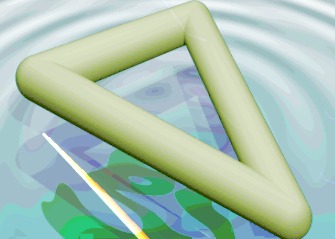
Owing to the game’s popularity, Cochran began a completely revised version for the next generation of computers in June 2000, writing his own portable rendering engine from scratch so that the game could be played and enjoyed for many years to come. D-Zone II was released in August 2004, with the same rich game play, enhanced graphics and robot intelligence, a script language for programming the robot tanks, and a haunting, space-odyssey-inspired composition by Cochran. The music was not written for the game: it is a draft from among his considerable output of concert works, still unpublished, that found a place in D-Zone II. By then the technology had advanced enough for his original vision to be realised in the game itself, as the screenshot below shows.
Cochran went on to train as a pure mathematician and nurture his development as a pianist and composer, his classical music performed regularly in halls around the world including Carnegie Hall, the Amsterdam Concertgebouw and the St Petersburg Philharmonic Hall.
Download D-Zone, free for Mac and Windows.